Monday, 12 May 2008

2009 Ford Mustang with Glass Roof

The latest in Ford's endless parade of variants of its macho Mustang muscle car is this pretty little pony: the 2009 "glass roof" Mustang. No, that's not its official name, but that's what Ford is calling any Mustang coupe equipped with the new $1995 option that will let the sunshine into the cabins of both V-6 and GT models in the summer of 2008.

In this case, however, letting in the sun should not be confused with letting in any fresh air, as the glass roof panel itself, which stretches from the windshield to the rear window, is fixed, neither sliding nor tilting. But it is big. And it's tinted and has a scrolling shade to help prevent its occupants from baking like a casserole under the summer sun.

Ford: Seeing the Light, or Beating a Horse That's Not Yet Dead?

Why a glass-roof Mustang? Ford cites increased customer demand for "more natural light" in cars and trucks. Ford credits that demand for a 200-percent increase since 2003 for "large sunroofs," like the one it offers in the Edge crossover. Ford further claims that among these customers are sports-coupe buyers, some 62 percent of whom in some way want to let the sunshine in, a need the Mustang coupe currently cannot satisfy.

Ford seems excited to be riding the upward side of a trend for a change. "Mustang is an icon in our product lineup, and we are committed to keeping Mustang news fresh every year," said Derrick Kuzak, Ford's group vice-president of global product development. "As the automotive landscape becomes increasingly competitive, features such as a panoramic glass roof will help differentiate our products from the competition."

Dearborn, You Have a Problem

We'd be excited, too, if not for Ford's addiction to creating Mustang derivatives, something that has contributed to a certain amount of Mustang fatigue within our ranks. After all, the glass-roof Stang will jockey for marketing dollars with two other Mustangs that are also "new" in 2008: the Bullitt and the GT500KR.

The glass-roof Mustang will make its official debut under the lights of the North American International Auto Show in Detroit, a show that we initially thought could (and should) host the première of the refreshed 2010 Mustang, which it seems Ford may be saving for the Chicago show in February to counter the debut of the Dodge Challenger.

What we'd really like to see instead of another Mustang, frankly, is a version of the European Ford Mondeo, or perhaps a decent Focus. But alas, until Ford gets its domestic-car program back up to snuff, expect Dearborn to remain a one-horse town.

2008 Dodge Viper SRT10 Coupe and Convertible - Short Take Road Test

Just 20 years ago, when Porsche and Ferrari unveiled the astonishing 444-hp 959 and the 478-hp F40 supercars, 400 horsepower was a very big number. Nowadays, the horsepower wars have gotten so crazy that there are a number of sedans—thank you, BMW and Mercedes—that muster at least 500 horsepower. The base Corvette now starts with 430 ponies, and there's a Mustang out there with 500 genuine horsepower—not the inflated SAE gross numbers that muscle cars of the 1960s claimed. So, to get attention nowadays, you need a really big number. Like 600 horsepower, which just so happens to be the figure produced by the latest Dodge Viper SRT10.

But the new Viper is more than a big horsepower number. While the Dodge engineers were extracting more grunt—horsepower has increased from 510 to 600 and torque from 500 pound-feet to 560—they tweaked many other aspects of the car, and the result is one spectacular automobile.

Let's start with that engine. By increasing the cylinder bore by one millimeter, the engine capacity went from 8.3 to 8.4 liters. A new block has cross-bolted main-bearing caps for better durability, and there are new cylinder heads, too. An ingenious cam within a camshaft uses hydraulic pressure to vary the exhaust valve timing by up to 40 degrees. All the valves are larger, and those on the intake side are now hollow. There is a new two-piece intake manifold and a tubular-header exhaust system that flows 20 percent better. And they've abandoned the old exhaust crossover pipes under the car, which created a huge amount of cabin heat.

With the increase in torque, Dodge went to a twin-plate clutch, an industry first, which it claims reduces rotating inertia by 18 percent. The six-speed Tremec manual transmission has been beefed up, with wider gears, triple-cone synchronizers on first and second, and a shifter with 30-percent-shorter throws. A speed-sensing GKN ViscoLok hydraulic clutch-pack-style differential is new.

The suspension retains its control-arm architecture all around, but there are myriad changes. The spring rates have been increased by five percent, the alloy-bodied Multimatic shocks have increased front and rear compression and decreased rear low-speed rebound, and the rear anti-roll bar is now solid rather than hollow. There is far more negative camber all around—up from 0.25 degree to 1.4 degrees at the front and from 0.6 to 1.2 degrees at the rear—and more front castor.

Externally, there are new wheel designs—all wrapped by Viper-specific Michelin Pilot Sport PS2 tires—and a much more aggressive hood that takes its inspiration from the Competition coupe: The extra slots have the benefit of extracting engine heat as well as increasing downforce. There are also some vibrant new exterior colors, including Snakeskin Green.

According to Dodge, the Viper now tops out at 202 mph. The convertible managed 197 in Dodge's testing with the top down, which is pretty impressive. According to our tests, the Viper (we tested a coupe) is monstrously fast from a standing start, blasting to 60 mph in 3.5 seconds and to 100 mph in 7.6 seconds. The quarter-mile rips past in a Corvette Z06-humbling 11.6 seconds at 126 mph. The last Viper we tested managed these increments in 3.8, 8.5, and 12.1 seconds at 120 mph, respectively.

But even better than the improved performance is the improved behavior. The Viper has always been pretty easy to drive quickly, but it always felt, well, a bit tame. Fast, sure, but you always expected a car that had more than 500 horsepower under your right hoof to feel more dramatic and quicker in its responses. The engine sounded a bit flaccid and was almost too linear in its power delivery, and the shifter was agricultural.

The first surprise in the new car is that the shifter is pretty sweet and much more positive in feel. On the street, you notice the Viper is still geared for supersonic speeds in sixth gear, but slam it down a couple of gears, and you realize that it's really, really quick. The engine now has a definite step in its power delivery at about three grand on the tach, yet it puts the 600 horsepower down amazingly well for a car that doesn't have traction control (or stability control, for that matter).The ride is pretty good, but the steering is too nervous off-center at normal speeds.

Find a more challenging road or, even better, head off to a track like Virginia International Raceway on the Virginia/North Carolina border, and the Viper comes alive. The car turns in much more readily than the old one did, and it's easier to rotate by breezing off the gas on corner entry, which helps to dial out its tendency to understeer. On the exit of the tighter bends, the car can be steered sideways on the throttle, but it remains super-stable on the high-speed sweepers at VIR.

The upshot of the changes is a car that was, despite high ambient temperatures, a full 4.2 seconds quicker around VIR's 4.2-mile Grand Course (the circuit we use for our Lightning Lap competition) than we managed with the old Viper and 0.8 second quicker than the previous champ, the Corvette Z06. On a cooler day, the margin would likely be higher. The convertible wasn't quite as good around VIR as the coupe, tending to snap from understeer to oversteer, but it was just as fast at the end of the straightaway, edging toward 160 mph.

As for faults, the exhaust note is more prominent than before, but it trails those of Ferraris, Porsches, Lamborghinis, and Z06s in aural excitement. The cabin isn't up to snuff for an $80,000-plus vehicle, and the seats are plain annoying, being too heavily bolstered and too long under your thighs. The Viper is not as usable everyday as a Corvette, either, but the snake is definitely more dramatic to look at and creates more of a stir.

The Viper remains, essentially, a toy rather than an everyday driver—but it's a mighty fine, explosively fast toy, especially on the track.


VEHICLE TYPE: front-engine, rear-wheel-drive, 2-passenger, 2-door coupe (all test numbers are from a coupe)

PRICE AS TESTED: $90,345 (base price: $86,045)

ENGINE TYPE: pushrod 20-valve V-10, aluminum block and heads, port fuel injection
Displacement: 512 cu in, 8382cc
Power (SAE net): 600 bhp @ 6000 rpm
Torque (SAE net): 560 lb-ft @ 5100 rpm

TRANSMISSION: 6-speed manual

DIMENSIONS:
Wheelbase: 98.8 in Length: 175.6 in Width: 75.2 in Height: 47.6 in
Curb weight: 3455 lb

C/D TEST RESULTS:
Zero to 60 mph: 3.5 sec
Zero to 100 mph: 7.6 sec
Zero to 150 mph: 17.0 sec
Street start, 5-60 mph: 4.2 sec
Standing ¼-mile: 11.6 sec @ 126 mph
Top speed (drag limited, mfr's claim): 202 mph
Braking, 70-0 mph: 150 ft
Roadholding, 300-ft-dia skidpad: 1.00 g

FUEL ECONOMY:
EPA city/highway driving: 13/22 mpg
C/D observed: 14 mpg


2009 Chevrolet Corvette ZR-1 or ZL-1? - Spied

There is not much left to the imagination in these latest spy shots of the supercharged Corvette that will finally make its official debut in January at the North American International Auto Show here in Detroit.

Really, what we're waiting for is confirmation of details on the monster engine shoved under that hood, and relief from this name game we've all been playing in anticipation of the car.

The latest consensus is ZR-1, and although it still is not official, we can at least categorically rule out a couple of contenders following an interview with General Motors vice-chairman Bob Lutz at the Frankfurt show.

It is not Blue Devil, the internal moniker that pays homage to Duke University, where CEO Rick Wagoner played basketball. In addition to the name being a bit of an inside joke, people would expect the car to be blue, Lutz tells Car and Driver. "We won't do a blue Corvette." (We assume he is referring just to the ZR-1 here, as there are other blue Corvettes on the road now.)

Nor will it be called SS (thankfully), as the letters are not a good designation in parts of Europe.

And Lutz rules out Sting Ray, noting it was such a "beautiful, unique car" that the pending Corvette would need its own body style to be worthy of the name, and that will not be the case. This baby is essentially a Z06 but looks lighter with what appears to be liberal use of carbon fiber in the A- and B-pillars, the roof, and perhaps the rocker and other body panels, not to mention a polycarbonate "window" in the hood. "We won't use Sting Ray for a Corvette that looks like any other Corvette," Lutz says.

That pretty much leaves Z07, ZR-1, and ZL-1. In August, Car and Driver editor-in-chief Csaba Csere suggested to top GM officials Lutz, Rick Wagoner, and Mark LaNeve that ZL-1 would be the most compelling designation. Chatter coming out of GM suggests ZR-1 or ZL-1 as the likely name.

Regardless of what it is called, demand is building for the car. People want it, Lutz tells us, and they don't ask about cost or fuel economy. "In addition to the environment-oriented market, there still is a huge market for people who want automobiles that go very fast and will pay for it."

The speed meets the approval of the jet-setting Lutz who describes recent stints driving prototypes as a "truly remarkable experience."

Our long-held contention is that the car is packing a 650-hp, 6.2-liter supercharged small-block V-8. GM's new LS9 will utilize an integrated intake-manifold intercooler, and it's expected to run a 0-to-60 dash in under 3.4 seconds.

The 6.2-liter V-8 will be built at GM's Performance Center in Wixom, Michigan, starting next July, and the spy photographer reports a mean and angry exhaust note.

To handle speeds expected in the 200-mph range, a wider, taller lip spoiler has been added to the back of this Corvette. The spoiler now runs almost the entire width of the car to increase downforce and keep those massive tires glued to the road.

This spied test car is riding on Michelin Pilot Sport ZP tires, seemingly confirming rumors of a switch from Goodyears. The rear tires appear to be a whopping 335/25R-20 size. A quick look inside the wheels also reveals a huge set of cross-drilled rotors and an equally large set of calipers in what appears to be a carbon-ceramic brake setup.

GM likely will build fewer than 2000 of these devils, so if you want one, make nice with your dealer now and renegotiate your mortgage.

Nor will it be called SS (thankfully), as the letters are not a good designation in parts of Europe.

And Lutz rules out Sting Ray, noting it was such a "beautiful, unique car" that the pending Corvette would need its own body style to be worthy of the name, and that will not be the case. This baby is essentially a Z06 but looks lighter with what appears to be liberal use of carbon fiber in the A- and B-pillars, the roof, and perhaps the rocker and other body panels, not to mention a polycarbonate "window" in the hood. "We won't use Sting Ray for a Corvette that looks like any other Corvette," Lutz says.

That pretty much leaves Z07, ZR-1, and ZL-1. In August, Car and Driver editor-in-chief Csaba Csere suggested to top GM officials Lutz, Rick Wagoner, and Mark LaNeve that ZL-1 would be the most compelling designation. Chatter coming out of GM suggests ZR-1 or ZL-1 as the likely name.

Regardless of what it is called, demand is bui

Our long-held contention is that the car is packing a 650-hp, 6.2-liter supercharged small-block V-8. GM's new LS9 will utilize an integrated intake-manifold intercooler, and it's expected to run a 0-to-60 dash in under 3.4 seconds.

The 6.2-liter V-8 will be built at GM's Performance Center in Wixom, Michigan, starting next July, and the spy photographer reports a mean and angry exhaust note.

To handle speeds expected in the 200-mph range, a wider, taller lip spoiler has been added to the back of this Corvette. The spoiler now runs almost the entire width of the car to increase downforce and keep those massive tires glued to the road.

This spied test car is riding on Michelin Pilot Sport ZP tires, seemingly confirming rumors of a switch from Goodyears. The rear tires appear to be a whopping 335/25R-20 size. A quick look inside the wheels also reveals a huge set of cross-drilled rotors and an equally large set of calipers in what appears to be a carbon-ceramic brake setup.

GM likely will build fewer than 2000 of these devils, so if you want one, make nice with your dealer now and renegotiate your mortgage. We expect the price tag for the 2009 ZR-1 to be in the $100,000 range.

lding for the car. People want it, Lutz tells us, and they don't ask about cost or fuel economy. "In addition to the environment-oriented market, there still is a huge market for people who want automobiles that go very fast and will pay for it."

The speed meets the approval of the jet-setting Lutz who describes recent stints driving prototypes as a "truly remarkable experience."


We expect the price tag for the 2009 ZR-1 to be in the $100,000 range.


Ford SVT


Ford's SVT—for Still Virile Team?—performance division is alive and well, executives insist as they prep an additional 1000 badges to slap on the limited-run 2008 Shelby GT500KR Mustang. The KR, for King of the Road, harkens back to the 1968 Mustang of the same name, and celebrates the King's 40th anniversary.

There only will be 1000 copies of the special edition KR when it sells out almost instantaneously in spring 2008. The KR will join the Shelby GT500 as the only current vehicles in the Ford kingdom to sport SVT badging.

Ford created its Special Vehicle Team in 1992 with the Mustang Cobra and F-150 Lightning pickup, followed later by hotter versions of the Ford Contour and Focus.

The automaker showed the world you don't have to be German to have a credible performance division.

But just as other automakers were catching on to the idea that performance vehicles are a great way to boost your image, create a young and loyal following, and sell hot cars without incentives, Ford's SVT team was reassigned.

Bill Ford's dream of a GT supercar had to become a reality in less than two years, and that meant all hands on deck.

SVT stopped creating new vehicles in 2002 and the last SVT-specific models, the Cobra and Focus, exited in 2004. Plans to add as many as five new SVT models, including an SVT Fusion, were set aside.

The hiatus ended with last year's 2007 Shelby GT500, Ford's most successful SVT project to date, and continues with the pending special edition GT500KR.

An SVT truck is in the works as well. Execs won't confirm it's the reanimation of the Lightning that was shelved indefinitely—but they do say they still see a lot of cachet in the Lightning name.

Work on the mystery truck started last fall, and will take longer than the GT500KR, which set a record development time of less than a year to modify the current-generation Mustang, embracing the donor platform down to the solid rear axle—despite the IRS vs. solid-axle wars that rage internally.

The SVT truck represents a bigger program, and those working on it are sworn to secrecy as to when it bows.

There currently are 74 full-time members of the SVT team. That might sound like a lot, given the size of the lineup, but it is a dramatic downsizing from about 200 in 2005 when the unit was done with the GT500 and back on track making performance variants of existing models.

Hermann Salenbauch, director of Advanced Product Creation and SVT, readily admits Ford can't afford to do a race-inspired supercar like the GT500KR every year.

And while Chrysler's strategy of its Street and Racing Technologies (SRT) unit is to make an SRT version of almost everything, Ford will focus on a few vehicles, produced in small batches.

And Ford is fully committed to SVT, Salenbauch said at a Dearborn unveil of the GT500KR. That car will be made public this week at the New York auto show, as well as a limited-edition 2008 F-150 Foose Edition and 2008 Ford Expedition Funkmaster Flex Edition. And the big debut in NY will be the long-awaited Flex, the production version of the Fairlane Concept that fills the vacancy left by Ford's exodus from the minivan market.

When it comes to growing the SVT line, the Mustang was a natural, Salenbauch said. Everyone loves a sports car, and competition is coming with the Dodge Challenger expected about April 2008 (as a 2008 model), followed by the Chevy Camaro in the first-quarter of 2009.

Performance divisions date back to BMW's M division, created with the E12 in 1979, and Mercedes' AMG tuning arm. AMG dates back to 1967 when a pair of former Mercedes engineers began designing and testing racing engines. Mercedes took over AMG in 1999 and it now is a wholly owned subsidiary of the automaker. It will show its latest effort in NY this week: the CL65 AMG with a 6.0-liter V-12 making 612 horsepower.

The two German houses of power have ruled ever since.

Ford's early success with SVT spurred its domestic competitors. Chrysler has been aggressive with its special models, creating SRT versions of Dodge, Chrysler and even Jeep cars and trucks. The fledgling initiative was born and flourished while product guru Wolfgang Bernhard was in the number-two chair at Chrysler. Bernhard had the right pedigree: he once was the head of AMG.

General Motors' Performance Division created the now-defunct Chevrolet SSR, Cadillac V-Series and a line of Chevrolet SS and Saturn Red Line models that leave their conventional starting points in the dust.

Currently, the tuners at GM and Chrysler are leaving SVT engineers staring at taillights.

Dodge Challenger SRT8 2008


We finally slap our test gear onto the potent Challenger SRT8 to see if it’s actually up to the challenge.

With so much presale buildup, we’ve told you bit by bit pretty much everything about Dodge’s old-meets-new Challenger SRT8. By now, the fundamentals should be familiar. The SRT8 is essentially a Charger SRT8 sedan with four inches cut from the middle and two fewer doors; it’s powered by the same 425-hp, 6.1-liter Hemi V-8 found in other SRT8 models in the Chrysler family; and it looks spectacular in orange. It also outguns the R/T and SE Challenger models that will be added for ’09.

What you might not know are some of the finer details. The 2008 SRT8 is the only Challenger to be designated as an ’08, and each of the 6400 U.S. cars—they are already sold out—gets a numbered plaque, orange seat stripes, and faux-carbon-fiber hood stripes. Also, the Challenger SRT8 debuts SRT’s brake “knock back” system that ensures the pads stay close to the discs during spirited driving as well as a “Performance Features” readout on the dashboard that displays acceleration, braking, and handling achievements for the driver’s amusement. The Challenger SRT8 starts at just over $40,000.

But until we shot up Angeles Crest Highway in the SRT8 at the press program in Pasadena, California, we hadn’t been able to log any significant drive time. Soon afterward, we got our paws on one at home in Ann Arbor and took it to the test track to get the numbers. Would the Challenger’s bad-ass attitude be backed up with genuine muscle-car street cred, or was Chrysler unable to mask the family sedan beneath the retrospective skin?

More Than Just Another Square-Jawed Muscle Car

The answer? Both. Thanks to that monster motor and a short first gear, the Challenger does earn a dollop of street cred, hitting 60 mph in 4.8 seconds, charging through the quarter-mile in 13.3 at 108 mph, and running to a drag-limited top speed of 168 mph.

But the Challenger SRT8 is more than just a drag-strip junkie. Its LX platform, for all its heft, does bring with it a sophisticated suspension that made easy work for Chrysler’s Street and Racing Technology team to engineer a combination of decent ride quality and tenacious grip, neither of which is a strong suit of muscle cars from bygone years (or, for that matter, of the current Ford Mustang). So, like any SRT8 product, it may be inescapably a family car in many ways, but it’s a fast and capable performance car, too.

Seriously Capable, but Where’s the Feel?

The multilink front and rear suspension is tuned for amazingly flat cornering, something vividly apparent on Angeles Crest Highway, where we flogged it left and right but watched the horizon that was the big, long hood stay level with the ground. Coupled with the sticky optional Goodyear F1 Supercar summer tires, the suspension imparted the Challenger with some pretty astonishing grip in corners. On the skidpad in Michigan, which admittedly was described as “really slippery” that day, the Challenger pulled a respectable 0.86 g with moderate understeer that can be corrected by the pedal on the right. But alas, with a curb weight of 4189 pounds, Chrysler was unable to mask the LX platform on which it’s based.

Missing from the equation was a great sense of steering feel that is somewhat slow to respond off-center despite its quick, constant-ratio rack and 2.75 turns lock-to-lock. Technical editor Mike Austin attributes the lack of steering feel, ironically, to the lack of body roll; when there’s no sense of heave-ho, set, and then bite, there is little impression of the car responding, even though it is, he explained. Then again, the lack of feel is strangely appropriate, if only for this car. “It’s an unintended throwback to the ’70s,” said Austin.

The same can be said for the brakes. Stopping a big, heavy coupe from 70 mph in an impressive 170 feet—the length of just four Greyhound buses—is no simple feat. Thank you, Brembo, for your help on each of the SRT8’s four corners. But as with the steering, feedback is another thing, and somewhat absent here, too. Our test car in L.A. had a good inch or so of pedal travel before anything at all happened, and our tester in Michigan was little better. We have to issue one caveat: These both were well-worn press cars, and not all cars at the California event suffered thusly. But here’s the obvious warning to future owners: These brakes can get worn out under constant abuse.

Unfortunately, this meant that we really couldn’t tell you whether or not Dodge’s new brake knock-back system is worth a darn. We appreciate the intuitiveness of the concept: When the g-sensor detects dynamic forces of more than 0.50 g, the brake pads are moved closer to the rotors to quicken brake actuation when ultimately called on. We’ll have to get a fresh car soon and lap a track with, say, a Dodge Charger SRT8 to see if there is a measurable difference.

Performance Features Display—Very Informative, Very Addictive

Another interesting—and seriously cool—new bit is the Performance Features display, which is part of the multi-information screen nestled into the gauge cluster. Several steps beyond the lateral-g meter available in the Chevy Corvette, Performance Features measures 0-to-60-mph, 1/8-mile, and 1/4-mile acceleration times, 60–0 braking distance, and g-forces in all four directions (either peak or real-time). At several points during our drive in California, we saw readings of 0.99 g left and right, but it’s worth noting that those were peak g-forces, not steady-state g as measured on a skidpad.

We did not have the opportunity to measure the Challenger’s readout against our test equipment for braking and acceleration, but we have verified the relative accuracy of such systems currently available in the aftermarket, so there’s no reason to believe that the Mopar system shouldn’t be accurate. A similar system is already in the Caliber SRT4, and we expect it to spread to other SRT products in the near future.

Also, expect your license to take a hit or two along what will certainly turn into a constant quest for a new personal performance best. Keep your eyes on the road. They hide in the bushes.

Oh, That Glorious Engine

Besides, they’ll hear you coming. Particularly under full tilt, the throaty, 6.1-liter engine is loud and furious. Wide-open throttle bathes all occupants in nearly 84 decibels of symphonic, mechanized glory characterized by crispness as well as volume. Around town, on the other hand, it is very calm and refined—rather quieter than we expected, especially at its 49-decibel idle.

It’s an engine that keeps on giving. Its 425 horsepower peaks at 6200 rpm, just 200 revs shy of its 6400-rpm redline. Torque is all over the place but peaks at a relatively lofty 4800 rpm. In other words, go ahead and hold that gear above where you’d normally shift in a Mustang, because there’s more power to come.

Too bad there aren’t more gears. The five-speed AutoStick automatic is a throwback to the DaimlerChrysler days, and with a shortened first gear for acceleration and a relatively tall fifth gear for fuel economy (its 168-mph top speed is achievable in fourth), the gears are simply too spread out. Indeed, on Angeles Crest and even on the track at Willow Springs, there were many moments when we wished third came a little closer to second, and fourth to third, if only so that we wouldn’t be dumped into a completely different part of the power band when shifting. At least the shifts themselves are very quick—thanks, SRT. Next year, a six-speed manual will be available in the SRT8 and R/T Challengers, and needless to say, we can’t wait.

Too Late for ’08

Speaking of next year, that’s the soonest you’ll be able to get one. Dodge is making just 6400 Challengers for 2008, all of which are SRT8s and all of which are sold. Dodge claims to have more than 10,000 orders for the SRT8, and certainly, many buyers will be willing to wait until the 2009 model year, which, incidentally is when the less powerful and less expensive Challenger R/T and SE models will join the party. Pricing is—or was—$40,158 to start, with fully loaded examples coming in around $42,000, including a sunroof, MyGIG entertainment with navigation, and the $50 summer-tire upgrade for those sexy 20-inch wheels.

We don’t expect pricing to change much for ’09, but the carbon-look hood stripes will become matte black, the orange seat stripes will become red, and the numbered plaque commemorating the first-year model will disappear.

Specs

VEHICLE TYPE: front-engine, rear-wheel-drive, 5-passenger, 2-door coupe

PRICE AS TESTED: $40,208 (base price: $40,158)

ENGINE TYPE: pushrod 16-valve V-8, iron block and aluminum heads, port fuel injection

Displacement: 370 cu in, 6059cc

Power (SAE net): 425 bhp @ 6200 rpm

Torque (SAE net): 420 lb-ft @ 4800 rpm

TRANSMISSION: 5-speed automatic with manumatic shifting

DIMENSIONS:

Wheelbase: 116.0 in Length: 197.8 in Width: 75.7 in Height: 57.0 in Curb weight: 4189 lb

C/D TEST RESULTS:

Zero to 60 mph: 4.8 sec

Zero to 100 mph: 11.4 sec

Zero to 150 mph: 30.8 sec

Street start, 5–60 mph: 5.1 sec

Standing ¼-mile: 13.3 sec @ 108 mph

Top speed (drag limited): 168 mph

Braking, 70–0 mph: 170 ft

Roadholding, 300-ft-dia skidpad: 0.86 g

FUEL ECONOMY:

EPA city/highway driving: 13/18 mpg

Sunday, 11 May 2008

Porsche 911SC


Engine: 3 litre, 6 cylinder, air cooled, 204 bhp.

Transmission: 5 speed gearbox with limited slip differential.

The car was first prepared and raced by Nick Adams in 1998. It has since been raced by Paul Stephens, Ian White and Mark Rogers in the Porsche Club Championship and has been prepared and maintained by Harvey Racing for most of its racing life.

After a hard season's racing in 2005, the car is currently being prepared by Harvey Racing for the 2006 season. 

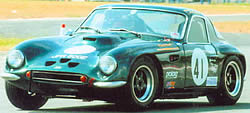
1967 TVR GRIFFITH 400 R/H Drive Ford V8 302


Engine rebuilt by Chris Shirle in 2002, new pistons, new holley carb,etc etc etc
Dyno tested at 380 bhp I 344ft lbs @ 5800 rpm
New cam/followers, timing gears/chain, push rods, roller rockers fitted by Chris
Shirle in 2004.
Ford T10 4 spd gearbox
Full roll cage
OMP plumbed in fire system
Full harness
Corbeau seats
Quick release steering wheel
Wilwood 4 pot front brakes
Rear in board discs on jag limited slip diff
Rear steel uprights
Koni shocks
15” Compomotive wheels with good Avon ZZ tyres
MSA log book
New chassis fitted in 1994
Mechanically excellent, body in dark metallic green, showing a few battle scars but generally good.
The car is fully road legal, tax exempt and has a current m.o.t.
I have owned the car since 1991 and have competed in hill climbs and sprints in a road going class since 1995, this car is well known and has been very successful.
Winner of The Welsh Association of Motor Clubs Sprint and Hill Climb
Championship in 2002,2003 and 2004.
It was a class winner in the WAMC Championships in 1996, 97, 98, 99, 2000 and
2001.
Winner of the Pre 1975 Classic class in The Midland Speed Championship in 2005
and 2 in the TVR class in 2002, 03, 04 and 2005.
Holder of class records at Aintree, Pembrey, Llandow, Wiscombe Park and Llys-y Fran.
The car is featured in John Tipler’s TYR
The Griffith Years by Mike Mooney
The TYR Griffith Story by Roger Shackleton

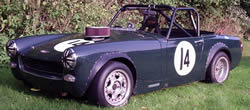
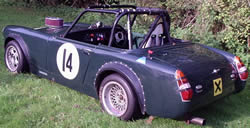
Austin Healey Sprite Race/Hillclimb car


Modified for hillclimb and race use fitted with highly tuned 135bhp 1330 A series engine, steel crank and rods, dry sump, roller rockers and downdraught Weber carb,

competition gearbox just rebuilt with close ratio straight cut gears, rear axle just rebuilt fitted LSD, complete with almost unused sets of slick and wets, full rollcage, new harness, plumbed in fire extinguisher, lightweight detachable hardtop. Many spares including good 1275 engine, gearbox, rear axle, spare axle ratios etc

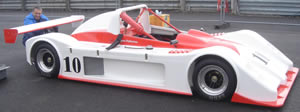
ADR3 Built 2006


Chassis built by Caged (who manufacture the chassis for Caterham)
Body by Datum Engine has been rebuilt/renewed by Karl the owner at Extreme engines and has had only 30 laps of running in since.
Dampers are 2 way adjustable Nitrons. Steering wheel is and ETB unit with all functions built in. The diff is and adjustable ramp angle Gripper unit by Tom Seal. During the build I included high spec rose joints (some 38!) throughout. The wiring loom is an ADR bespoke system with built in options for lighting. A set of new wheels and wets come with the car along with spare side skirts. As an idea of the cars potential it has done 1.04 on the Silverstone national circuit on its second outing; there with no prior race experience and reported as havin some requirement to dial out understeer. I would envisage the car not having a problem running with Radicals which run around 1.01 in experienced hands.

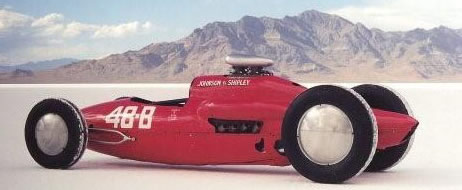
Land Speed #48-B belly Tank Bonnieville Racer


This historic 1955 Johnson and Shipley B-Lakester red #48-B belly-tank racer holds a number of Bonnieville National Speed Trials land speed records such as the 1963 B-Lakester 255.501 MPH (taken from Tom Beatty, car #100B) and 1964 A-Lakester at 263.350 MPH. Famed land speed racer Don Johnson piloted the car and partner Jeff Shipley took care of the motor and car. The car was bought from legendary racer Roy Fjasted, who owned and raced the car until 1961. The car is one of three cars built by Car Craft Machine and one of a handful of early belly-tank racers known to exist. Car #28 is usually in the Petersen Automotive Museum. Car #100B sold at Monterey 2007 for $440,000. This remaining car has been in a private collection since 1991. The body is made from a P-51 Mustang drop tank. The car has a correct 331 CID Chrysler hemi V-8 motor with 6-71 GMC supercharger and 2 port Hilborn fuel injection. Power is delivered to a Gilmor in-and-out box and quick-change rear end. The car has been featured in numerous publications from 1963 to 1999. The 48-B was shown by invitation at Bonnieville in 1998. The car is a restored rolling display and of course needs to be rebuild mechanically to race again. It is a fully-documented car and comes with the Bonnieville B trophy, documentation and photo history. For any serious race car collector or museum, this is a must-have one-of-a-kind classic Lakester.